

What Are Adjectives and Why Are They Important?
Adjectives are a type of word that modifies a noun or a pronoun. They tell us more about its qualities or characteristics.
Using adjectives helps you communicate more clearly and express your opinions and feelings. They add color and detail to your sentences.
- They answer questions like ‘What kind?’ or ‘Which one?’.
- For example, in a delicious cake, delicious tells us ‘what kind’ of cake it is.
🎓 Englisch lernen mit der Blended-Methode
Kleingruppen · KI-Tutor rund um die Uhr · Vorbereitung auf die Cambridge-Prüfungen
Pläne von $39 $79 pro Monat
Wie verwenden wir Adjektive im Englischen?
Adjectives usually appear in two main positions in an English sentence.
- Vor einem Substantiv: The adjective comes directly before the noun it describes. For example: It was a strange story.
- After a ‘be’ verb (or other linking verbs): The adjective describes the subject of the sentence. For example: The story was strange.
Adjectives for Describing Things and Experiences
Many adjectives help us talk about objects, events, and situations. These words often express an opinion or a strong feeling.
- Amazing: Very surprising or impressive. The concert was amazing!
- Awful: Very bad or unpleasant. The weather was awful yesterday.
- Boring: Not interesting; causing boredom. That movie was so boring.
- Delicious: Very pleasant to taste or smell (usually food). This pizza is delicious.
- Horrible: Very bad, unpleasant, or shocking. I had a horrible dream last night.
- Perfect: As good as it is possible to be. Your English is perfect!
- Strange: Unusual or surprising. I heard a strange noise.
Adjectives for Describing People and Feelings
We also use adjectives to describe people’s appearance, personality, or how they feel.
- Gorgeous: Very beautiful or attractive (often for people or things). She looked gorgeous in her new dress.
- Lovely: Pleasant or enjoyable; beautiful. What a lovely smile!
- Rude: Not polite; showing a lack of respect. It’s rude to interrupt people.
- Serious: Not joking or playing; thoughtful. He is a very serious student.
- Silly: Foolish or not serious. Don’t be silly, it’s easy!
- Ugly: Unpleasant to look at. That old building is quite ugly.
- Alright: Acceptable, satisfactory, or well. I feel alright today.
| Positive Adjectives | Negative Adjectives |
|---|---|
| Amazing | Awful |
| Delicious | Boring |
| Gorgeous | Horrible |
| Lovely | Rude |
| Perfect | Ugly |
| Alright | Strange (can be negative) |
Beispiele
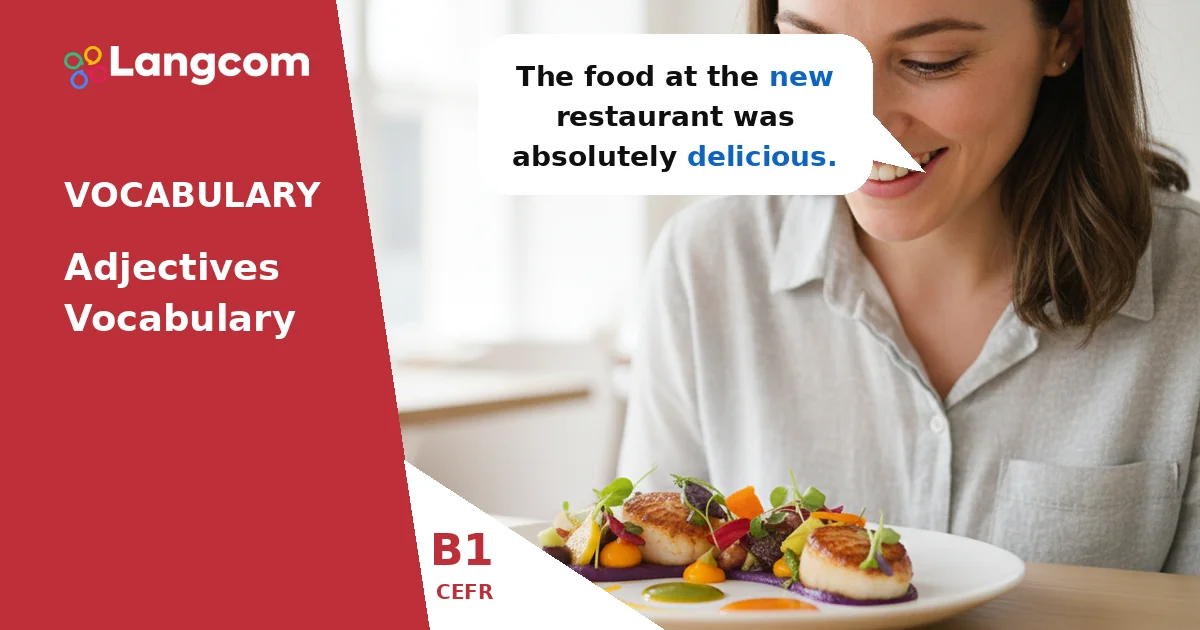
- The food at the new restaurant was absolutely delicious.
- She wore a gorgeous dress to the party.
- I found the lecture incredibly boring.
- It was an awful mistake to make.
- Everyone said the concert was amazing.
- He can be very rude sometimes.
Übung
✍️ Du bist dir nicht sicher, auf welchem Niveau du bist?
Machen Sie unseren kostenlosen Einstufungstest und erhalten Sie individuelles Feedback von zertifizierten Cambridge-Prüfern.
Machen Sie unseren KOSTENLOSEN EinstufungstestHäufige Fehler bei Spanischsprechern
Spanish speakers sometimes make mistakes with adjective placement or confusing similar-sounding adjectives.
- Placement: In English, adjectives almost always come vor the noun. Do not put them after the noun.
❌ a house big
✅ a big house - -ing vs. -ed adjectives: Be careful with adjectives ending in -ing und -ed.
Boring describes something that causes boredom (e.g., The book is boring.).
Bored describes the feeling of boredom (e.g., I am bored.).
❌ I am boring. (Unless you mean you cause boredom to others!)
✅ I am bored.
Häufig gestellte Fragen
Can adjectives describe feelings?
Yes, many adjectives describe feelings, like happy, sad, excited, oder bored. For example, I feel amazing today.
Do adjectives change for plural nouns?
No, adjectives in English do not change their form for plural nouns. For example, you say a big house und big houses. The adjective big stays the same.
Can I use more than one adjective for a noun?
Yes, you can use multiple adjectives to describe a single noun. For example, It was a long, boring meeting. Or She has a lovely, gorgeous smile.
What is the difference between ‘awful’ and ‘horrible’?
Beides awful und horrible mean ‘very bad’ or ‘unpleasant,’ and they are often interchangeable. Horrible can sometimes suggest something that causes fear or shock more strongly than awful.




0 Kommentare