

When do we use the Present Simple?
We use the Present Simple to talk about things that are permanent or happen regularly.
- Habits and Routines: These are actions you do often or every day. I drink coffee every morning.
- General Truths and Facts: Dinge, die immer wahr sind. The sun rises in the east.
- Permanent Situations: Things that stay the same for a long time. She lives in London.
- Schedules and Timetables: For public transport, cinema times, or class schedules. The train leaves at 7 PM.
Common time expressions for the Present Simple include: always, often, usually, sometimes, never, every day/week, on Mondays.
🎓 Englisch lernen mit der Blended-Methode
Kleingruppen · KI-Tutor rund um die Uhr · Vorbereitung auf die Cambridge-Prüfungen
Pläne von $39 $79 pro Monat
When do we use the Present Continuous?
We use the Present Continuous to talk about actions that are happening at a specific time around now.
- Actions Happening Now: Things that are in progress at the moment of speaking. He is watching TV right now.
- Temporary Actions: Situations that are true for a short time only. They are studying English this semester.
- Changing Situations: Trends or developments that are happening now. The climate is changing rapidly.
- Annoying Habits (with ‘always’): When someone does something too often and it bothers you. He is always complaining!
Common time expressions for the Present Continuous include: now, right now, at the moment, currently, today, this week, these days.
What are Stative Verbs?
Some verbs describe states, feelings, or opinions, not actions. We call them stative verbs. They are usually not used in continuous tenses.
Here are some common stative verbs:
- Feelings/Emotions: love, hate, like, prefer, want, need
- Thoughts/Opinions: know, understand, believe, remember, forget, think (meaning ‘believe’)
- Senses: hear, see, smell, taste, feel (when not describing an action)
- Possession: have (meaning ‘possess’), own, belong
- Existence/Appearance: be, seem, appear
For example, you say I know the answer, nicht I am knowing the answer.
How do Present Simple and Present Continuous compare?
The key is to think about whether an action is regular/permanent or temporary/in progress.
- Regular vs. Happening Now:
I work at a bank. (Present Simple: a permanent job)
I am working on a new project. (Present Continuous: a temporary activity now) - General Truth vs. Temporary Situation:
Birds fly. (Present Simple: a general truth)
The birds are flying south for the winter. (Present Continuous: a temporary action this season) - Stative Verbs: Always use Present Simple for these. She loves chocolate. (NOT She is loving chocolate.)
| Betreff | Present Simple (+) | Present Simple (-) | Present Simple (?) | Present Continuous (+) | Present Continuous (-) |
|---|---|---|---|---|---|
| I | I work | I don’t work | Do I work? | I’m working | I’m not working |
| You/We/They | You work | You don’t work | Do you work? | You’re working | You aren’t working |
| He/She/It | He works | He doesn’t work | Does he work? | He’s working | He isn’t working |
Beispiele
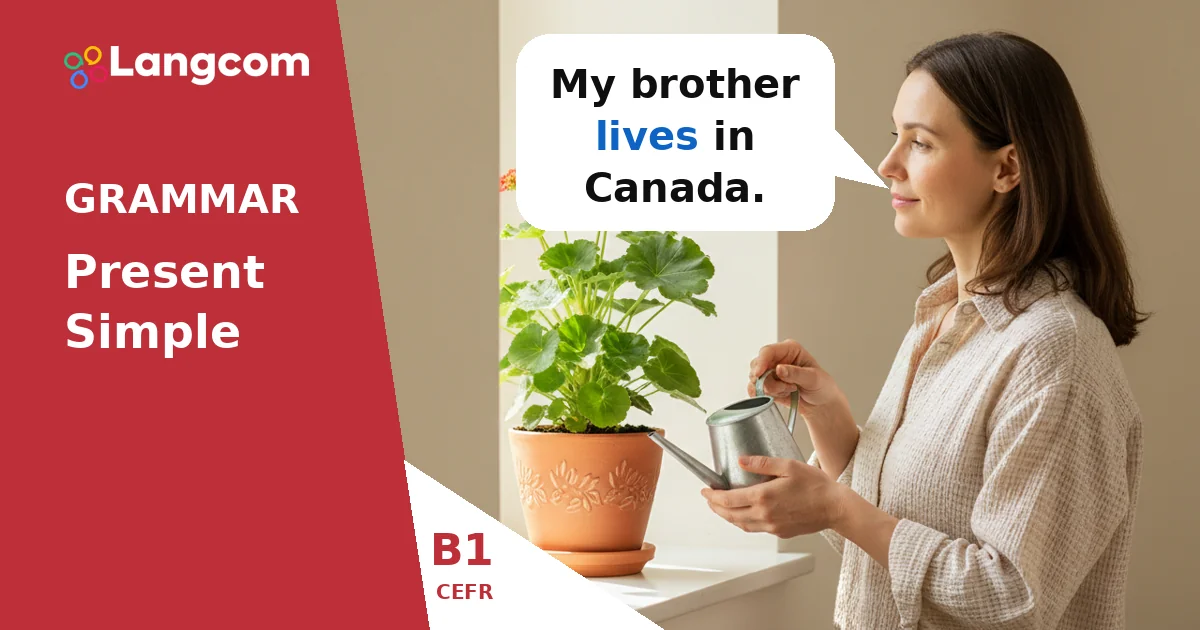
- My brother lives in Canada.
- They usually go to the beach in summer.
- The Earth revolves around the sun.
- Look! It is raining outside.
- We are having dinner with friends tonight.
- I don’t understand this question.
- Are you listening to music?
- She is always losing her keys!
Übung
✍️ Du bist dir nicht sicher, auf welchem Niveau du bist?
Machen Sie unseren kostenlosen Einstufungstest und erhalten Sie individuelles Feedback von zertifizierten Cambridge-Prüfern.
Machen Sie unseren KOSTENLOSEN EinstufungstestHäufige Fehler bei Spanischsprechern
Spanish speakers often make these mistakes:
- Using Present Continuous for Stative Verbs:
❌ I am wanting a new car.
✅ I want a new car. - Using Present Simple for actions happening now:
❌ What do you do? (while looking at someone painting)
✅ What are you doing? - Using Present Continuous for habits:
❌ I am going to the gym every Tuesday.
✅ I go to the gym every Tuesday. (Unless expressing annoyance)
Häufig gestellte Fragen
What is the main difference between Present Simple and Present Continuous?
The Present Simple is for regular actions, facts, and permanent situations. The Present Continuous is for actions happening at the moment of speaking or for temporary situations around now.
Can I use ‘always’ with the Present Continuous?
Yes, but usually to express annoyance or criticism about a repeated action. For example, He is always interrupting me! For regular, non-annoying habits, use the Present Simple: He always helps me.
Do these tenses have future meanings?
Yes. The Present Simple is used for scheduled events (timetables): The concert starts at 8 PM. The Present Continuous is used for definite future plans: We are meeting John tomorrow.
Are there verbs that can be both stative and dynamic?
Yes, some verbs like have, think, be, see can be stative or dynamic depending on their meaning. For example, I have a car (stative, possession) vs. I am having lunch (dynamic, action).



0 Kommentare