

What is the Present Simple Tense?
The Present Simple tense is one of the most common tenses in English. We use it to talk about things that are always true or happen regularly.
Think of it as the ‘everyday’ tense. It helps you describe your daily life and general information.
✍️ Vous ne savez pas quel est votre niveau ?
Passez notre test de niveau gratuit et recevez des commentaires personnalisés de la part d'examinateurs certifiés par Cambridge.
Passez notre test de niveau GRATUITWhen Do We Use the Present Simple?
We use the Present Simple in several situations:
- For habits and routines: Actions you do regularly, every day, every week, etc.
- I drink coffee every morning.
- She goes to school by bus.
- For facts and general truths: Things that are always true.
- The sun rises in the east.
- Cats eat fish.
- For schedules and timetables: Fixed events like train times, cinema showings, or class schedules.
- The train leaves at 7:00 AM.
- The film starts at 8:30 PM.
- For opinions and feelings: To express what you like, love, hate, or think.
- I like pizza.
- He thinks English is interesting.
How Do We Form the Present Simple?
The form of the Present Simple changes slightly depending on the subject of the sentence.
Affirmative Sentences
- For I, you, we, they, we use the base form of the verb.
- I play football.
- They live in London.
- For he, she, it, we add -s ou -es to the base form of the verb.
- He plays football.
- She lives in London.
Spelling Rules for -s / -es
- Most verbs: add -s (e.g., work → works, eat → eats).
- Verbs ending in -ch, -sh, -s, -x, -z, -o: add -es (e.g., watch → watches, go → goes, finish → finishes).
- Verbs ending in a consonant + -y: change -y à -ies (e.no-translation>study → studies, fly → flies).
- Verbs ending in a vowel + -y: just add -s (e.g., play → plays, enjoy → enjoys).
Negative Sentences
Nous utilisons do not (don't) ou does not (doesn't) + the base form of the verb.
- For I, you, we, they: use do not ou don't.
- I don't play football.
- They don't live in London.
- For he, she, it: use does not ou doesn't.
- He doesn't play football.
- She doesn't live in London.
Questions
Nous utilisons Do ou Does at the beginning of the question + subject + base form of the verb.
- For I, you, we, they: use Do.
- Do you play football?
- Do they live in London?
- For he, she, it: use Does.
- Does he play football?
- Does she live in London?
For 'Wh-' questions (e.g., What, Where, When), put the 'Wh-' word first.
- Where do you live?
- What does she do?
| Subject | Affirmative | Negative | Question |
|---|---|---|---|
| I / You / We / They | I work. | I don't work. | Do you work? |
| He / She / It | He works. | He doesn't work. | Does he work? |
Exemples
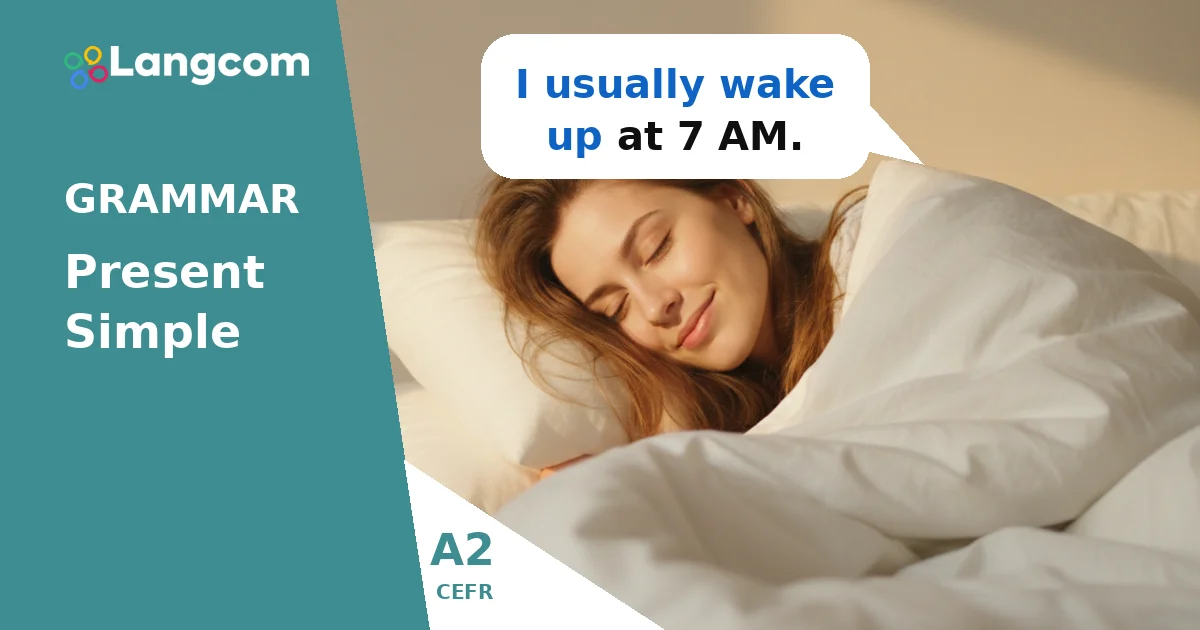
- I usually wake up at 7 AM.
- My brother works in a bank.
- We don't watch much TV.
- She doesn't like spicy food.
- Do you speak English?
- Does it often rain here?
- What time does the shop close?
Entraînement
Ready to earn your certificate?
Langcom prepares students for Cambridge, IELTS, TOEFL, DELE, SIELE and Michigan exams.
Get started with LangcomErreurs courantes chez les hispanophones
Spanish speakers sometimes make these common mistakes with the Present Simple:
- Forgetting the -s for he/she/it:
Incorrect : He work every day.
Correct : He works every day. - Using is/are with the main verb for negatives/questions:
Incorrect : I am not like coffee.
Correct : I don't like coffee.
Incorrect : Are you live here?
Correct : Do you live here? - Adding -s to the main verb after do/does in questions/negatives: N'oubliez pas que, do/does carries the tense.
Incorrect : Does she works?
Correct : Does she work?
Incorrect : He doesn't likes apples.
Correct : He doesn't like apples.
Questions fréquemment posées
What is the main use of the Present Simple tense?
The main use of the Present Simple is to talk about habits, daily routines, general facts, and fixed schedules. It describes actions that happen regularly or are always true, like I get up early ou Water boils at 100°C.
How do I add -s or -es to verbs for 'he/she/it'?
For most verbs, you just add -s (e.g., eat → eats). If a verb ends in -ch, -sh, -s, -x, -z, -o, you add -es (e.g., watch → watches, go → goes). If a verb ends in a consonant + -y, change -y à -ies (e.g., study → studies).
Can I use the Present Simple for future events?
Yes, you can! We use the Present Simple to talk about future events that are part of a fixed timetable or schedule, like public transport, cinema times, or school lessons. For example, The bus arrives at 10 AM tomorrow.
How is the Present Simple tested in the A2 Key exam?
In the A2 Key (KET) exam, the Present Simple is often tested in Reading and Writing Part 6 (Open Cloze) or Part 7 (Word Transformation), where you might need to complete sentences with the correct verb form or change a verb to its Present Simple form to fit the context of daily routines or facts.

0 commentaire