

What Are Adjectives and Why Are They Important?
Adjectives are a type of word that modifies a noun or a pronoun. They tell us more about its qualities or characteristics.
Using adjectives helps you communicate more clearly and express your opinions and feelings. They add color and detail to your sentences.
- They answer questions like ‘What kind?’ or ‘Which one?’.
- For example, in a delicious cake, delicious tells us ‘what kind’ of cake it is.
🎓 Изучайте английский по смешанной методике
Небольшие группы · ИИ-репетитор 24/7 · Подготовка к экзаменам Кембриджского университета
Планы от $39 $79 в месяц
Как мы используем прилагательные в английском языке?
Adjectives usually appear in two main positions in an English sentence.
- Перед существительным: The adjective comes directly before the noun it describes. For example: It was a strange story.
- After a ‘be’ verb (or other linking verbs): The adjective describes the subject of the sentence. For example: The story was strange.
Adjectives for Describing Things and Experiences
Many adjectives help us talk about objects, events, and situations. These words often express an opinion or a strong feeling.
- Amazing: Very surprising or impressive. The concert was amazing!
- Awful: Very bad or unpleasant. The weather was awful yesterday.
- Boring: Not interesting; causing boredom. That movie was so boring.
- Delicious: Very pleasant to taste or smell (usually food). This pizza is delicious.
- Horrible: Very bad, unpleasant, or shocking. I had a horrible dream last night.
- Perfect: As good as it is possible to be. Your English is perfect!
- Strange: Unusual or surprising. I heard a strange noise.
Adjectives for Describing People and Feelings
We also use adjectives to describe people’s appearance, personality, or how they feel.
- Gorgeous: Very beautiful or attractive (often for people or things). She looked gorgeous in her new dress.
- Lovely: Pleasant or enjoyable; beautiful. What a lovely smile!
- Rude: Not polite; showing a lack of respect. It’s rude to interrupt people.
- Serious: Not joking or playing; thoughtful. He is a very serious student.
- Silly: Foolish or not serious. Don’t be silly, it’s easy!
- Ugly: Unpleasant to look at. That old building is quite ugly.
- Alright: Acceptable, satisfactory, or well. I feel alright today.
| Positive Adjectives | Negative Adjectives |
|---|---|
| Amazing | Awful |
| Delicious | Boring |
| Gorgeous | Horrible |
| Lovely | Rude |
| Perfect | Ugly |
| Alright | Strange (can be negative) |
Примеры
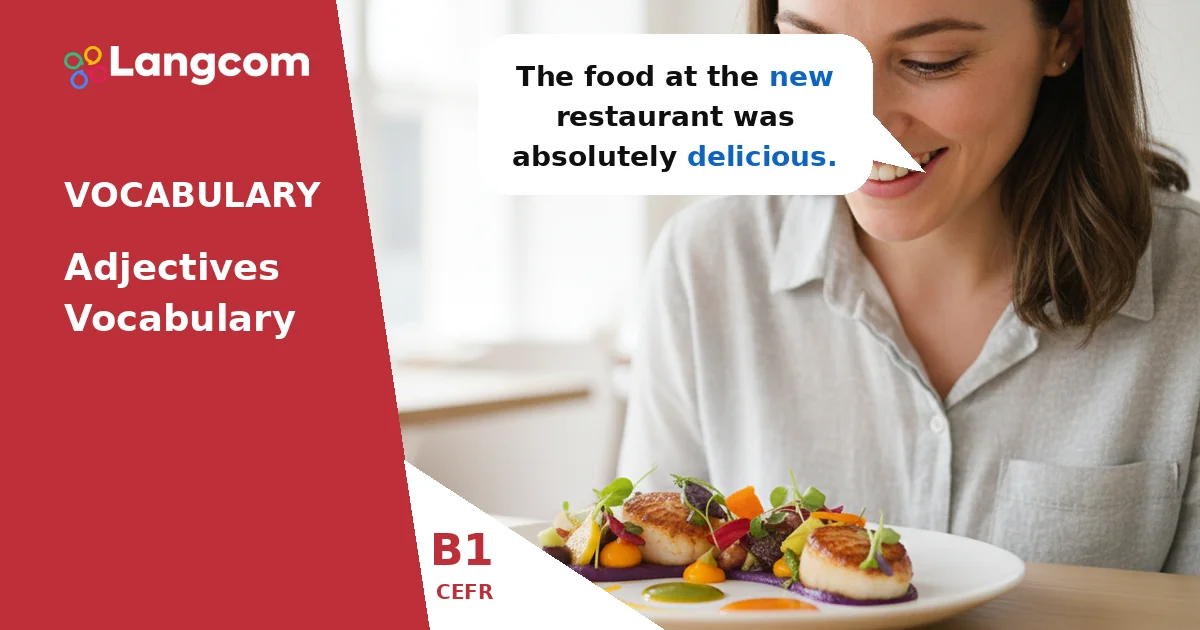
- The food at the new restaurant was absolutely delicious.
- She wore a gorgeous dress to the party.
- I found the lecture incredibly boring.
- It was an awful mistake to make.
- Everyone said the concert was amazing.
- He can be very rude sometimes.
Практика
✍️ Not sure which level you are?
Take our free placement test and get personalized feedback from certified Cambridge examiners.
Пройдите наш БЕСПЛАТНЫЙ тест на определение местаРаспространенные ошибки у носителей испанского языка
Spanish speakers sometimes make mistakes with adjective placement or confusing similar-sounding adjectives.
- Placement: In English, adjectives almost always come до the noun. Do not put them after the noun.
❌ a house big
✅ a big house - -ing vs. -ed adjectives: Be careful with adjectives ending in -ing и -ed.
Boring describes something that causes boredom (e.g., The book is boring.).
Bored describes the feeling of boredom (e.g., I am bored.).
❌ I am boring. (Unless you mean you cause boredom to others!)
✅ I am bored.
Часто задаваемые вопросы
Can adjectives describe feelings?
Yes, many adjectives describe feelings, like happy, sad, excited, или bored. Например, I feel amazing today.
Do adjectives change for plural nouns?
No, adjectives in English do not change their form for plural nouns. For example, you say a big house и big houses. The adjective big stays the same.
Can I use more than one adjective for a noun?
Yes, you can use multiple adjectives to describe a single noun. For example, It was a long, boring meeting. Or She has a lovely, gorgeous smile.
What is the difference between ‘awful’ and ‘horrible’?
Both awful и horrible mean ‘very bad’ or ‘unpleasant,’ and they are often interchangeable. Horrible can sometimes suggest something that causes fear or shock more strongly than awful.




0 Комментариев